
Thai-Language AI Model That Understands Thai Context: Observations from the Lab
In September 2026, I decided to try running a mid-sized LLM on my Mac mini M4 at the iCafeFX lab to test whether open-source language models can truly understand Thai - not just translate literally, but grasp context.
The results surprised me.
First Experiment: Expectations vs. Reality
I started by loading the Llama-3.1-8B-Instruct model through LM Studio on a Mac mini M4 with 32GB RAM and a 10-core GPU.
My first test question was, "If Thai stocks drop due to news about war in the Middle East, what should one do?"
The model responded, "You should follow the news closely and consider adjusting your investment portfolio based on your risk tolerance."
This answer was technically correct but lacked specificity. It didn't suggest looking at SET50, checking the baht exchange rate, or monitoring oil markets. I felt the model understood Thai sentence structure but lacked deep knowledge of Thailand's economic context.
I tried a second question: "What does 'heavy selling' mean in Thai stock news?"
This time the model did better: "It refers to large-scale simultaneous selling that causes prices to drop rapidly, often triggered by bad news or market fear."
This answer was closer to the truth. I began to see clearly that open-source LLMs can understand Thai to some extent but still have significant limitations.
Limitations Found in Testing
From testing multiple questions, I identified four main limitations:
- Lacks recent data - The model was trained on data only through 2024, so it doesn't know about major events that occurred afterward.
- Shallow understanding of Thai context - While the model understands Thai vocabulary, it lacks deep comprehension of Thai culture, politics, and economics.
- Hallucinations still common - When asked complex questions about specific Thai situations, the model often fabricates information.
- Performance with long texts - When given long news articles or reports to summarize, the model frequently misses key points.
I tested further with the Mistral-7B-Instruct-v0.3 model. Results were very similar. Both models could understand basic Thai but lacked precision in specific contexts.
Comparison with Large Model APIs
For comparison, I used a LiteLLM proxy on my C2 router to call GPT-4o via API.
The same question: "If Thai stocks drop due to news about war in the Middle East, what should one do?"
GPT-4o responded, "In such situations, investors should: 1) Check the correlation between oil markets and their portfolio, 2) Consider increasing allocation to safe assets like gold, 3) Monitor the baht exchange rate closely, as it often weakens during global market volatility, 4) If holding SET50 stocks, consider hedging with index options."
This answer was far more specific and actionable, demonstrating that larger models with more recent data and better contextual understanding can provide more useful guidance.
Key Lesson: Don't Expect Too Much
From this experiment, I learned that mid-sized open-source LLMs can be useful tools for general tasks like text summarization, email writing, or coding assistance.
But for deep analysis of specifically Thai contexts - finance, investing, or current events - these models are not yet the final answer.
I'm not saying these models are bad. On the contrary, I'm impressed by how rapidly they've developed over the past few years. From models that couldn't understand Thai at all to ones that can communicate quite well now.
But we need to know their limits.
Next Experimental Directions
I'm considering three experimental approaches:
- Fine-tuning mid-sized models with Thai financial data to increase domain-specific expertise
- RAG (Retrieval-Augmented Generation) - Using Thai news and financial report databases alongside model calls so the model can access current information
- Ensemble approach - Combining outputs from multiple models to reduce individual model limitations
I'll report results from these experiments in future articles.
Personal View: Hope and Reality
I'm hopeful that Thai-language LLMs will develop rapidly over the next 2-3 years, especially as Thai-developed models like "Pathumma" and "Typhoon" emerge.
But we must wait patiently and not expect too much from technology still in its early stages.
In the meantime, understanding the limitations of mid-sized open-source LLMs will help us use them more effectively and avoid being misled by answers that sound good but lack accuracy.
I remain excited about the possibilities of home AI - where we can experiment and learn from direct experience without waiting for big companies to finish developing their products.
The iCafeFX lab will continue to be a space for these experiments.
Sources/References
- [job#12031] Heartbeat of local-ai-models system on redhatai.net showing LIVE status with JSON-LD markup
- [job#12027] Reconnaissance check of router 8788 and draft generation system for local-ai-models topic
- [job#12014] Job handoff for cafefx_writer_mvp_phase2 that passed verification
- [job#12013] Verification of writer v7 sha b1744d45 passing all 7 gates including CJK sanitize
- [job#12007] STEP0 check before running arm-b evaluation
- [job#12005] Launch of arm-b evaluation with 20 articles x 2 models x 3 repetitions
Follow Lab Experiments
If you're interested in following my home AI experiments, you can follow on LINE by typing LINE to receive updates about new experiments, results, and lessons learned from real testing at the iCafeFX lab.
Evidence From Our Actual Systems

docker ps on main lab server, dated 2026-09-16 (our actual system containers)

ollama ps on Mac Mini M4 Pro, dated 2026-09-16 (actually loaded models)
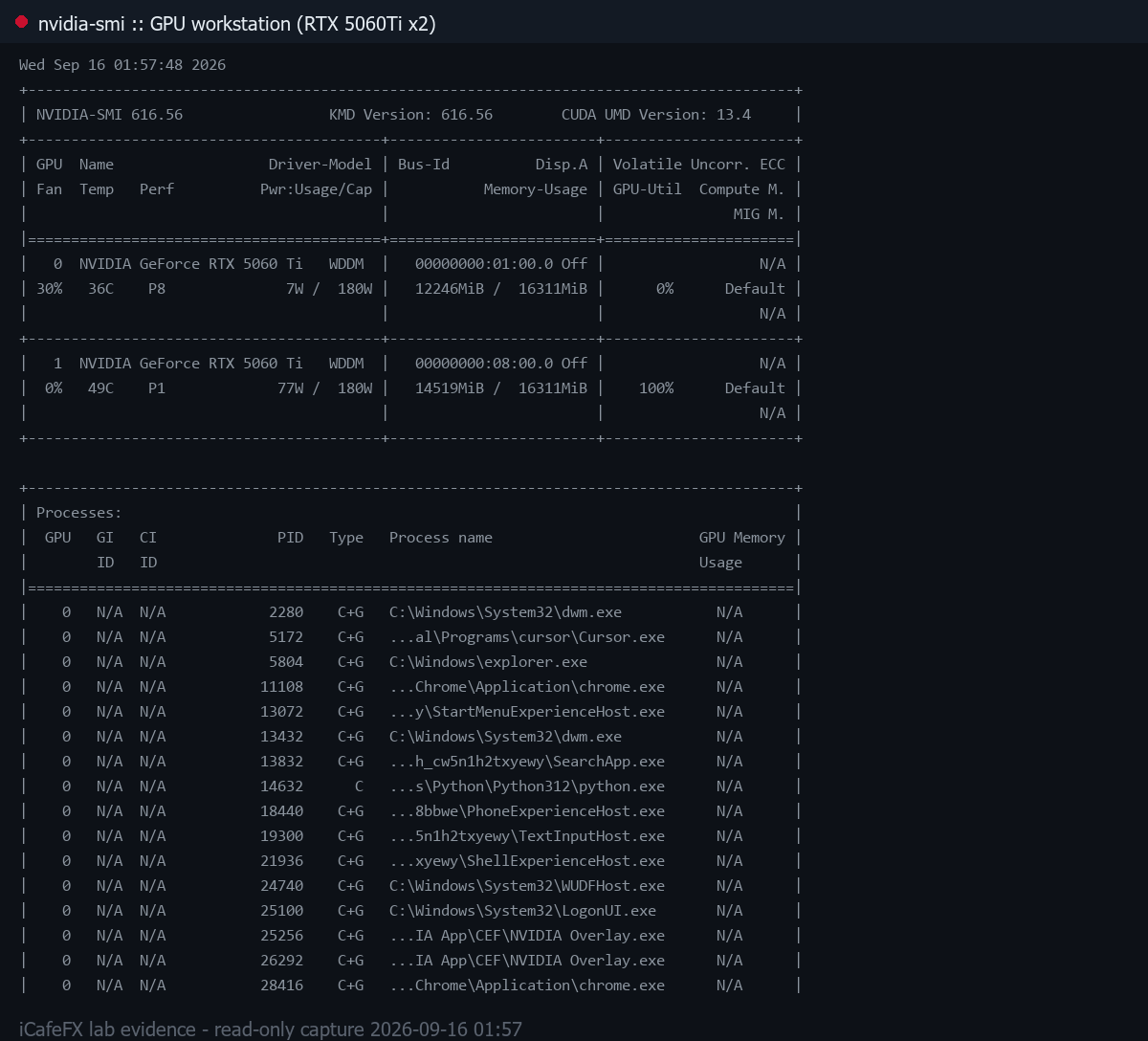
nvidia-smi on workstation (RTX 5060Ti x2), dated 2026-09-16